In the rapidly evolving landscape of industrial sustainability, the management of wastewater has shifted from a regulatory burden to a strategic opportunity. For decades, industries ranging from food and beverage to pharmaceuticals have relied on traditional filtration methods.
However, as the global economy transitions toward a circular model, these legacy systems are proving inadequate. Enter Selective Molecular Capture, the core innovation behind Valorix, which is redefining how we perceive and process industrial waste.
Table of Contents
Moving Past Conventional Membranes: Why Traditional Filtration Fails
Traditional membrane technologies, such as Ultrafiltration (UF) and Reverse Osmosis (RO), operate primarily on the principle of size exclusion. They act as sophisticated sieves, blocking particles based on their physical dimensions. While effective for basic water purification, these methods face three critical failures when dealing with complex industrial streams:
Chemical Complexity: Industrial wastewater is not just “dirty water”; it is a rich soup of organic acids, proteins, and polyphenols. Traditional membranes cannot distinguish between a toxic pollutant and a high-value bioactive compound if they are of similar molecular weight.
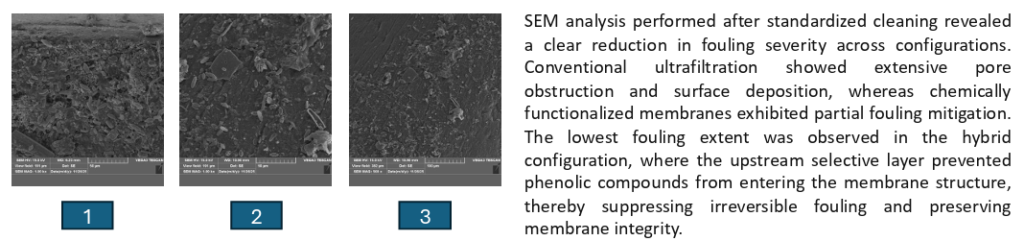
The Fouling Crisis: In traditional systems, the membrane surface quickly becomes “clogged” or fouled by organic matter. This leads to a dramatic drop in flux, requiring frequent chemical cleaning (CIP) and high energy consumption, which shortens the membrane’s lifespan and inflates OPEX.
Concentration Polarization: As particles build up on the membrane surface, they create a secondary barrier that hinders separation efficiency. Traditional systems struggle to overcome this without massive pressure increases.
Valorix moves beyond these limitations by shifting the focus from physical size to chemical affinity.
The Science of the Selective Layer: Understanding Molecular Affinity
The breakthrough of Selective Molecular Capture lies in the “functionalized surface” of the Valorix membrane. Instead of just being a barrier, the membrane surface is engineered with specific chemical sites designed to “grab” target molecules.
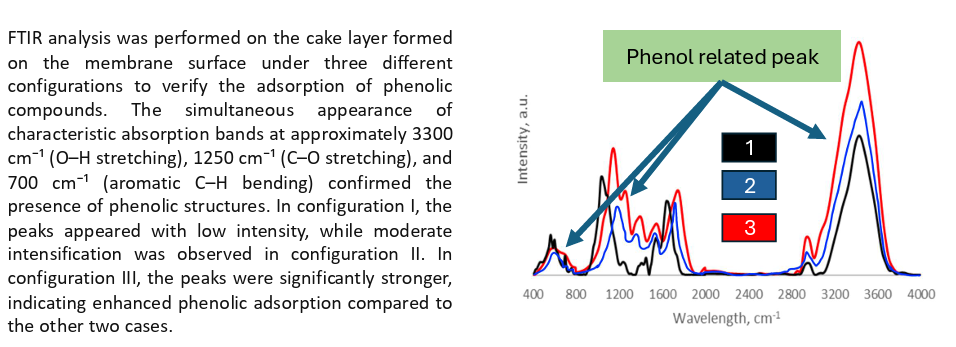
$\pi$-$\pi$ Interactions: Many high-value compounds, such as phenolic antioxidants found in olive mill wastewater, possess aromatic rings. Valorix membranes use $\pi$-$\pi$ stacking interactions to selectively bind these rings, allowing water and salts to pass through while capturing the value.
Ionic Bonding and Hydrogen Bridges: By tuning the surface charge and functional groups (such as carboxyl or hydroxyl groups), the membrane can selectively attract or repel specific ions and polar molecules.
Molecular Recognition: This is not passive filtration; it is active, targeted capture. It allows the system to recover molecules that are far too small for ultrafiltration but too valuable to be discarded via reverse osmosis.
A Modular Solution to Fouling: The Sacrificial Layer Innovation
One of the most innovative aspects of the Valorix design is its Modular Cassette System. Fouling is inevitable in wastewater treatment, but Valorix handles it differently through the concept of a “Sacrificial Layer.”
In the Valorix module, the selective layer is not a permanent, irreplaceable part of the expensive base membrane. Instead:
Functional + Replaceable: The active capture layer is designed to be refreshed. Once the capture sites are saturated with target molecules (like polyphenols), the module allows for the easy recovery of these compounds and the “renewal” of the surface.
Modular Assembly: Using a unique 4-screw locking system or snap-fit design, operators can replace the active cassettes without replacing the entire membrane unit. This reduces maintenance time and ensures that the system always operates at peak efficiency.
Protection of the Base Membrane: By acting as a sacrificial barrier, this layer prevents internal fouling within the porous structure of the PVDF/PES base membrane, significantly extending the hardware’s life.
Efficiency by the Numbers: Low Energy, High Value
The transition to Selective Molecular Capture isn’t just a scientific curiosity; it is an economic necessity. Traditional extraction of bioactive compounds usually requires massive amounts of organic solvents (like ethanol or hexane) and energy-intensive evaporation steps.
Valorix changes the math:
Low-Pressure Operation: Unlike Reverse Osmosis which requires high osmotic pressure, Selective Molecular Capture operates at low pressures (often <1 bar). This results in a massive reduction in energy consumption.
Pre-Concentration without Heat: The technology concentrates valuable molecules directly on the membrane surface. This eliminates the need for heat-based evaporation, preserving the bioactivity of sensitive compounds (like antioxidants) which would otherwise degrade.
Solvent-Free Recovery: By using pH shifts or mild aqueous eluent instead of toxic solvents, Valorix ensures that the recovered product is “Green” and “Natural,” making it highly desirable for the nutraceutical and cosmetic markets.
Conclusion: The Future is Selective
The era of “one-size-fits-all” filtration is coming to an end. As industrial regulations tighten and the value of natural functional ingredients skyrockets, the ability to selectively capture molecules from waste streams will define the winners of the next industrial revolution.
Valorix is not just cleaning water; we are mining it for the resources of the future. By combining advanced material science with a modular, energy-efficient design, we are proving that sustainability and profitability are not just compatible—they are inseparable. The rise of Selective Molecular Capture is here, and it is transforming waste into the high-value streams of tomorrow.